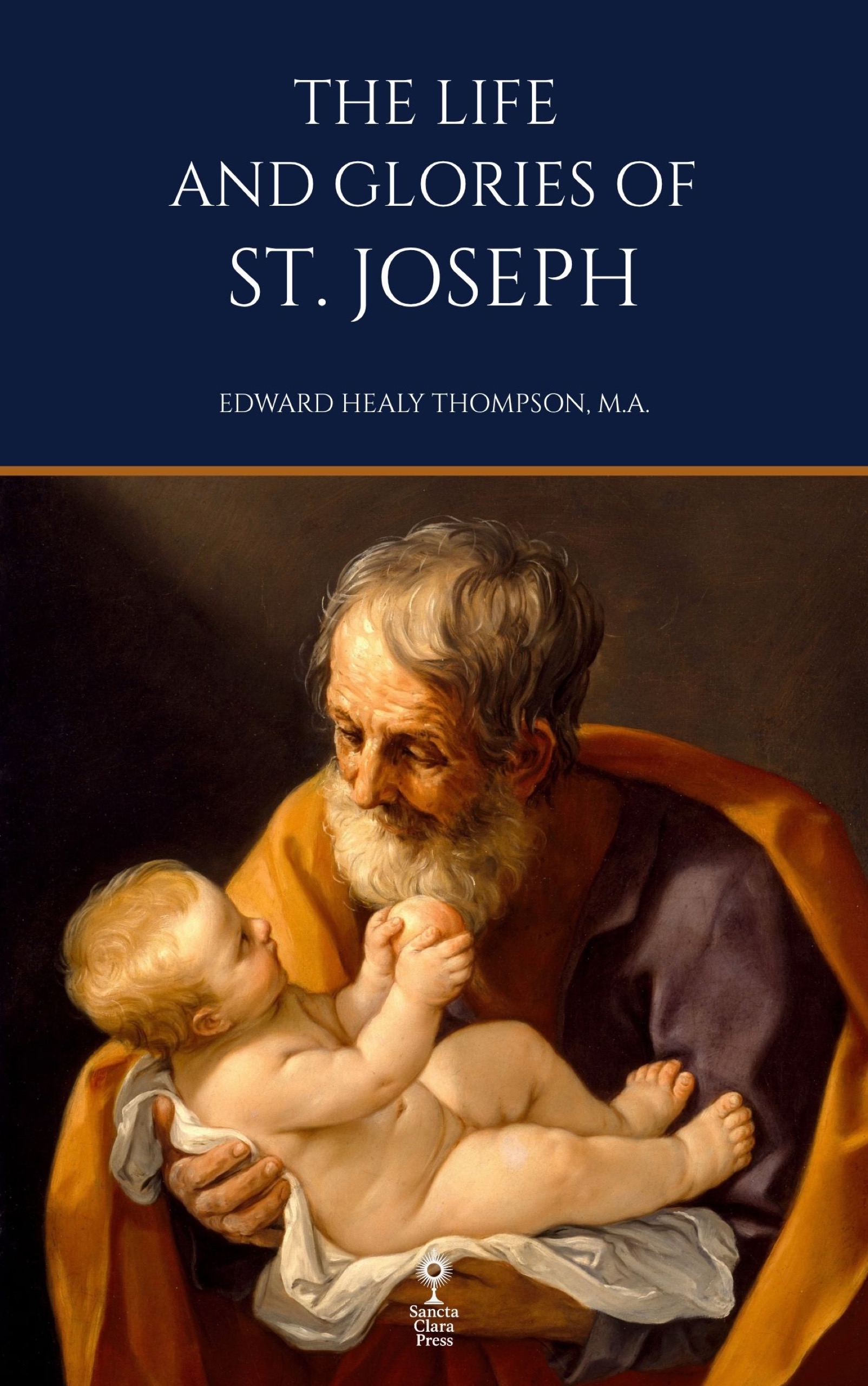
The Life and Glories of St. Joseph
by Edward Healy Thompson, M.A. (1888)
Edward Healy Thompson's classic life of St. Joseph (Burns & Oates, 1888): what Scripture, the Fathers, the saints and the theologians have said of the Spouse of Mary and Foster-Father of Jesus, from God's eternal decree to his patronage of the universal Church. Restored from the first edition, with Scripture in the Douay-Rheims, and free to read here in full.
Front matter
Contents· 49 chapters, about 160,000 words, all free to read
- Chapter I. Joseph Included in the Decree of the Incarnation
Joseph indissolubly associated with Jesus and Mary. The eternal decree. Its mode of accomplishment included therein. Joseph predestined to his office. The ground of all his greatness.
- Chapter II. Joseph Included in the Order of the Hypostatic Union
Divers orders in the hierarchy of grace. The highest that of the Hypostatic Union. Joseph has place in this order. The doctrine no mere private opinion. Conclusions of theologians. Joseph's exalted honor. His preeminence over all saints. His superiority to the angels. Head of the Holy Family. Representative of the Eternal Father. His graces commensurate with his dignity. Our interest therein.
- Chapter III. Joseph Prefigured in Holy Scripture as to His Name, His Life, and His Glory
Abundance of Scripture evidence. Joseph prefigured by the patriarch of the Old Testament. Patristic testimonies. Decree of the Holy See. Joseph prefigured in name. In parentage. In superiority of grace and merits. In the patriarch's government of Putiphar's house. In his exaltation at the court of Pharao. In the honors paid him.
- Chapter IV. Joseph Prefigured in His Goodness, Clemency, and Generosity towards His Devout Clients, and Foreshadowed in Various Other Ways
His clemency prefigured in the patriarch's provision for the people. In his treatment of his brethren. Pharao's injunction to obey his Viceroy. Like obedience required for obtaining Joseph's favor. He is prefigured by Eliezer and Mardochai. In many other persons and forms. St. Francis de Sales's application of a passage in the Canticles.
- Chapter V. Joseph of a Most Noble and Royal Lineage
Nobility of birth a boon from God. Joseph no ignoble artisan. Greatness of his ancestry. Last link in the Messianic genealogy. His genealogy that of Mary and Jesus.
- Chapter VI. Joseph the Son of Jacob and also the Son of Heli
Contradiction between St. Matthew and St. Luke impossible. The two genealogies mutually reconcilable. One the natural, the other the legal genealogy. Two different opinions among theologians. The second the more eligible. Heli identified with Joachim. Junction of the two lines. Glory accruing to Joseph.
- Chapter VII. Joseph Sanctified before His Birth
Other saints sanctified before birth. Joseph entitled to priority. This privilege befitting his place and office. His sanctification a special object of the Divine Goodness. Two ways in which his sanctification before birth might be effected. Opinion of some pious writers that Joseph was preserved from the stain of original sin. The doctrine commonly approved by doctors of the Church, that he was sanctified from the first moments of his life. This grace befitting the reputed father of Jesus and the spouse of His Virgin Mother. The doctrine generally held and believed.
- Chapter VIII. Concupiscence Subdued in the First Sanctification of Joseph by the Superabundance of Grace, Which Was Greater in Him than in Any Other Saint except Mary
Concupiscence the penalty of sin. Joseph entitled to speedy liberation therefrom. This special grace befitted his sublime ministry, as also his superiority over angels and saints. Declarations of theologians and doctors thereon. P. Segneri's panegyric of St. Joseph. Emphatic statements of Suarez and Cartagena. Conclusion drawn by Benedict XIV. Our Lord's words respecting St. John Baptist not opposed to Joseph's preeminence.
- Chapter IX. Joseph the Harbinger of Redemption—He belongs to the New more than to the Old Testament
Joseph compared to the white light of dawn. The precursor of Mary, the Aurora, and of Jesus, the Sun of Justice. In what sense he belonged to the Old Law and in what to the New. The Church has always regarded and venerated him as her own. He opened the gates of the Christian dispensation and closed those of the Mosaic.
- Chapter X. Joseph's Family and Parentage
In Joseph all the virtues of his progenitors were combined and perfected. In him all the promises made to the Patriarchs were fulfilled. Little before the world, he was great in the eyes of God. Mary's descent from David. Name of Joseph's mother not recorded. Question as to the month in which he was born. Wednesday honored as his day. Four claimants for his birthplace. Bethlehem's claim indisputable. Visit in spirit to his cradle.
- Chapter XI. The Birth of Joseph a Joy in Heaven and in Limbo
The birth of saints a cause of rejoicing. The Blessed Trinity glorified in Joseph. His birth a source of gladness to the angels. Joseph inferior to them in nature, but superior in dignity. In what sense he needed their guardianship. Many angels appointed to attend upon him. These ministering spirits employed by Joseph in the service of mankind. His birth a joy to the souls in Limbo.
- Chapter XII. The Birth of Joseph a Joy on Earth
His birth a joy to his parents. His name not accidental. Reasons for believing it was bestowed on him by God. Its deep signification. A name of power and benediction.
- Chapter XIII. Joseph's Childhood and Youth
Joseph a first-born son. His presentation in the Temple. Jerusalem under Roman domination. Joseph brought to the Paschal solemnity. Jerusalem the abode of Joachim and Anne. The scepter departs from Juda. Fears inspired by Herod. His cruelties and crimes. Joseph brought up amidst anxieties and perils. His hidden life. His brother Cleophas. Joseph no illiterate mechanic. Learned in the science of the saints and in the mysteries of God.
- Chapter XIV. Joseph's Vow of Virginity
His espousals with Mary a sufficient proof. Testimonies of the Fathers. The doctrine taught by St. Thomas and St. Francis de Sales. Asserted by the Bollandists. Argument drawn from the analogy of the Earthly to the Heavenly Trinity. From Joseph's place in the order of the Hypostatic Union. From his being the representative on earth of the Eternal Father. From his superiority to the angels. Joseph the first to make a vow of virginity. Its source in a special grace and in the Saint's humility. Joseph to be congratulated and invoked.
- Chapter XV. Joseph a Just Man—His Occupation
Import of the term "just". Joseph faithful in his duty to God; to his neighbor; and to himself. Singularly and preeminently just. He precedes the Just One. False inferences from his exercising a trade. His state in life neither mean nor contemptible. Explanation of the language used by his fellow-townsmen. His employment that of Jesus Himself. His motive in embracing a life of toil. His love of poverty. His occupation that of a carpenter. Testimonies thereto. Joseph the patron and protector of working-men. His profound humility.
- Chapter XVI. Birth of Mary—Her Presentation in the Temple
Joseph's vow divinely rewarded. His residence in Jerusalem. His intimate association with Joachim and Anne. They are reproached for their sterility. Mary's immaculate conception. Her use of reason before birth. Her nativity. She is offered to God in the Temple. Her presentation and abode therein. Testimonies thereto.
- Chapter XVII. Mary's Abode in the Temple—Her Marriage with Joseph Decreed in Heaven
Mary's vow of virginity. Its transcendent merit. Estimation of virginity among Hebrews and pagans. Mary's life in the Temple both active and contemplative. Marvels related of her. Mary a world in herself; Joseph's consequent dignity and graces. Similarity between him and Mary. Testimonies to this. Joseph's perfection implied in his being chosen as husband of Mary.
- Chapter XVIII. Testimony of the Synagogue to the Virtues of Joseph
Joseph chosen by God to be the spouse of Mary. Their marriage the most perfect of unions. The Synagogue employed to effect it. Solicitude of the priests to provide Mary with a spouse worthy of her. Her silence concerning her vow of virginity. Many claimants of the alliance. Joseph not of the number; he is selected for his merits.
- Chapter XIX. Betrothal of Mary and Joseph
The testimony of God to Joseph's merits. Blossoming of his rod. Traditions on the subject. Joseph's knowledge of Mary's vow. Her consent deliberate and free. Her choice of Joseph. The high encomium implied therein. Mary gave him her heart. The two one in spirit and life. Illustrations of this. Mary's *fiat* the seal of her consent. Period of two months between the betrothal and the espousals.
- Chapter XX. Age of Joseph at the Time of the Espousals—His Personal Appearance
His advanced age neither credible nor fitting. Testimony of ancient sculptures and paintings opposed thereto. He was probably of mature age. The relative value of arguments drawn from monuments and those which rest on reasons of suitability. Motives for representing St. Joseph as an aged man. Representations of his extreme youth a protest against apocryphal fables. The testimony of St. Justin Martyr to Joseph's personal appearance. Private revelations on the subject. Description of the Blessed Virgin. Her nuptial robe and ring.
- Chapter XXI. The Espousals of Mary and Joseph
Mary's one scene of pomp upon earth. Mary and Joseph renew their vows of virginity. Remarks of St. Francis de Sales. Motive of the renewal. An example to all ages. The marriage of Mary and Joseph a true and valid marriage. Their previous vow of virginity no bar to their union. Their subsequent vow no derogation from its validity. Reasons why the Mother of Jesus should be married. The marriage no obscuration of the virginity either of Mary or of Joseph. Joseph's true title to preeminence.
- Chapter XXII. Life at Nazareth
Joseph's virtues henceforth destined to be known. He and Mary leave Jerusalem for Nazareth. Distribution of their goods. Joseph recognized by Mary as her head. The Holy House. Mary's domestic employments. Modesty and simplicity of the household. What our Lady said to St. Bridget respecting Joseph. His reverence, love, and devotion to Mary. Her love and reverence for Joseph. St. Leonard's panegyric on the Spouse of Mary. The blessings derived by Joseph from her society. Extract from the *Conference* of St. Francis de Sales. Effects on Joseph of knowing himself to be the spouse of one so holy and exalted.
- Chapter XXIII. The Annunciation
Mary and Joseph supremely rewarded for their love of virginity. Gabriel sent to the Virgin-Spouse of Joseph. The event announced to the heavenly hosts. Mary rapt in prayer. Gabriel's glorious ingress. Mankind to be no longer under the rule of angels. Mary full of grace and truly blessed. Why she was troubled at the angel's salutation. Two great truths included in Gabriel's words. The Incarnation dependent on Mary's consent. By her *fiat* the world is saved.
- Chapter XXIV. The Visitation
Mary's prevision of the sufferings of Jesus. Her motives for not imparting her secret to Joseph. She communicates to him the angel's intimation respecting Elizabeth. The object of Mary's visit to her cousin. Reasons for concluding that Joseph accompanied her. The contrary opinion inadmissible. Testimonies of saints and doctors. Question as to the city in which Zachary and Elizabeth abode.
- Chapter XXV. Mary and Joseph's Abode in Zachary's House
How Elizabeth was Mary's cousin. Their mutual salutations; their employments. Reasons for believing Joseph to have prolonged his stay in Zachary's house till Mary's departure; and that Mary remained till after Elizabeth's delivery. Testimonies of saints and doctors thereto. Answers to two objections. The birth and circumcision of John. Return to Nazareth.
- Chapter XXVI. Joseph's Trial
Renewal of labors and charities. Increase of divine favors accorded to Mary. Secret influences experienced by Joseph. His discovery of Mary's pregnancy. Effects produced on his mind thereby. Different views entertained by the Fathers. The Espousals anterior to the angel's appearance to Joseph. Meaning of the term rendered "to put her away". Import of the epithet "just" as applied to Joseph. His motives for leaving Mary. General agreement of Fathers and Doctors on the subject.
- Chapter XXVII. Joseph's Vision
Mary's silence and patience. Joseph speedily delivered from his distress. The angel's address to him. His tranquilizing words. Their true signification. Joseph's reflections on awaking. Analogy between Mary's election and that of Joseph. Renewal of their holy contest. Joseph's demeanor as head of the Holy Family.
- Chapter XXVIII. The Paternity of Joseph
Concurrence of the Blessed Trinity in the angelic message to Joseph. He was, in a sense, true father of Jesus. The model on which the Sacred Humanity was formed. Adopted as His father by the Son of God. Treated as such by Him. His paternity the reward of his merits. Implied in his being the husband of Mary, and the son of David. Witness of the New Testament genealogies thereto. Implied further in Joseph's marital rights. Mary's concession to him of a share in her rights. Joseph substituted by the Holy Ghost as her visible spouse. His paternity recognized and honored in Heaven.
- Chapter XXIX. Interior of the Holy House—Journey to Bethlehem
Mary's desire to obey and serve her spouse. Joseph's grief thereat; his acquiescence in the will of God. Revelations of the life in the Holy House. Homage paid by angels and by the animal creation to its inmates. Their boundless charity and liberality. Their poverty and want. The prophecy of Micheas; its fulfillment left by them to God. The edict of Augustus. Joseph's solicitude for Mary. Honor paid in Scripture to the ass. Journey to Bethlehem; trials of the way. Names enrolled. Shelter everywhere denied. Mary's serenity, Joseph's anguish.
- Chapter XXX. The Stable at Bethlehem
The cave in the rock. Outside the town. Its solitude and seclusion. Presence of angels. Joseph's supernatural trance. Mary ravished in ecstasy. Her delivery. Jesus shown to her in glorified form. Colloquy of Mother and Child, as symbolized in the Canticles. Joseph's first sight of Jesus. Homage paid by the ox and the ass. Traditions of other miraculous occurrences.
- Chapter XXXI. The Adoration of the Shepherds—The Circumcision
Joseph's assumption of the prerogatives of paternity. The immensity of the dignity. His relation to the Universal Church. Construction of the cradle. Appearance of angels to shepherds. Why they were thus favored. The heavenly light noticed only by them. Gabriel the Angel of the Incarnation. Visit of the shepherds to the cave. Not their only visit. Traditions and memorials of them. Abode of the Holy Family in the cave. Tradition respecting the Probatic Pool. The Circumcision. Joseph the minister of the rite. He bestows the name of Jesus.
- Chapter XXXII. The Adoration of the Magi
The Epiphany always a joyous mystery to the descendants of the Gentiles. Question as to who the Magi were. Kings, and three in number. Their names. The motive of their journey. The star of prophecy. Their reception at Jerusalem. Guided by the star to Bethlehem. The stable the scene of their adoration. Joseph present thereat. Their stay probably prolonged. Their further history and relics.
- Chapter XXXIII. Purification of the Blessed Virgin and Presentation of Jesus in the Temple
Mary's submission to the Law. Departure from Bethlehem. Joseph's reliance on God's protection. Mary's rest under a terebinth. The journey to Jerusalem an august procession. Simeon enlightened by the Holy Ghost. His twofold prediction. Testimony of Anna the Prophetess. The purification of Mary. She makes the offering of the poor. Jesus borne into the Court of the Priests. Unworthiness of the Jewish priesthood. The Presentation. Departure from the Temple.
- Chapter XXXIV. A Question of Dates
Reasons assigned for postponing the visit of the Magi. The reason drawn from the words of St. Luke creative of new difficulties. A simple explanation confirmed by St. Luke himself. Harmony of the Gospels. The reason drawn from the age of the children ordered to be slain convertible the other way. The Grotto of Milk. Return of the Holy Family to Bethlehem. The contrary opinion untenable. Motive for returning. Incidental confirmation derived from the words of St. Matthew. Jesus a Nazarite.
- Chapter XXXV. Flight into Egypt—Massacre of the Innocents
Joseph warned to fly into Egypt with the Child and His Mother. This office most honorable to him. Ratifies his title of father. The warning given, not to Mary, but to Joseph, as head of the Holy Family. Reasons why Egypt was chosen as the place of refuge. Joseph's unquestioning obedience. The Holy Family guided by angels. They pass by Hebron. Slaughter of the babes. Its extent. The Innocents true martyrs. Relics of them collected by St. Helen.
- Chapter XXXVI. Journey in the Desert—Destruction of Idols
The road taken by the Holy Family. They are sheltered by robbers. Supported by angels. They visit various places. Destruction of temples and idols. Consternation among the Egyptians. Joseph an Apostle to them. Temple of the Sun at Heliopolis. Conversion of Aphrodisius the high priest. Abode at Matarieh. Traditions respecting the Blessed Virgin. Pious act of the Empress Eugénie.
- Chapter XXXVII. The Offices of Joseph
Reasons why he did not accept the hospitality of Aphrodisius. Three obligations imposed on him. First, that of providing Jesus with bodily sustenance. Second, that of being His preceptor. Growth of Jesus in wisdom and knowledge. Joseph's third office, that of guardian. These obligations personal.
- Chapter XXXVIII. Abode in Egypt—Recall from Exile
The sorrows of exile. Deprivation of religious rites. The straits of poverty. The seamless tunic. Compassion for the babes of Bethlehem and their parents. Separation from relatives. Death of Herod. Question as to the length of the abode in Egypt. Why prolonged. Mission of the Holy Family. Prophecy of Isaias. The divine Apostolate. Miracles ascribed to the Infant Jesus. Mary and her holy spouse Apostles to the heathen. Appearance of angel to Joseph in sleep; import of his words. Departure from Egypt. Joseph's fears. He is again visited by an angel.
- Chapter XXXIX. Abode at Nazareth—Education of Jesus
Herod Antipas. Why Jesus was called a Nazarite. The grace in His Soul. St. Luke instructed by the Blessed Virgin. Import of his language respecting Joseph. Jesus educated by His parents. Observations of Vincenzo de Vit thereon. Imitation and curiosity characteristic of children. Instance of Jesus asking questions.
- Chapter XL. The Finding of Jesus in the Temple
Obligation of visiting the Temple on the three great feasts. The Child Jesus accompanies His parents at the feast of the Pasch. Remains behind in Jerusalem. Why He was not missed. His loss discovered at Machmas. The sorrow of Joseph like that of Mary. De Vit's mode of accounting for their conduct not admissible. Meaning of the term "three days". Unwearying search on the part of Mary and Joseph. Jesus found. Subject of His discourse with the Doctors. His answer to Mary's remonstrance. The nature of His parents' ignorance regarding it. He returns with them to Nazareth.
- Chapter XLI. The Subjection of Jesus
Hidden life of Jesus. Eighteen years spent in obedience to His parents. This obedience His own free choice. Analogous to His obeying the Mosaic Law, and becoming man. He chose to be dependent on Joseph as His father. This no derogation from the super-eminence of Mary. Joseph treated by angels as head of the Holy Family. His incomparable dignity. Not shared by the highest angels. Employment of Jesus in the workshop of Nazareth. A real subjection. His docility to His parents' will. Joseph's consummate prudence and rectitude. His authority like that of God. Extract from the Pastoral Letter of the Bishop of Nottingham.
- Chapter XLII. Joseph's Interior Life of Prayer and Contemplation
The inner life the true life of man. Joseph's life like that of the saints in Heaven. Testimony of the Church. Life of the saints in Heaven a life of light, and love, and bliss. St. Joseph's state of ecstasy and union with God. Angelic visitations made to him in sleep; the import of this. His continual contemplation of heavenly things. A single word all-comprehensive; instances. Joseph's life one of habitual divine illumination.
- Chapter XLIII. Joseph's Singular Faith and Supernatural Wisdom
Two special perfections in Joseph. His prompt and unquestioning faith. Holy Scripture affords no equal example. Instances of its marvelous perfection. Joseph's supernatural wisdom. Mary's confidence in his lights and unhesitating obedience to his directions. The value of her testimony.
- Chapter XLIV. Joseph's Love and Life of Bliss
His silence. His largeness of heart. His ever-increasing love for Jesus. His intimate knowledge of Him. His toils and sufferings on His account. His service a service of the spirit. His life an anticipation of the bliss of Heaven. Purity of soul necessary to its enjoyment. Participation of his senses in the joy of his soul. His bliss on earth meritorious. He is favored with revelations of the glory of Jesus. His delight in the caresses of the Divine Infant. Protest against a false and hurtful idea of Joseph's character. His habitual state of contemplation no hindrance to his observance of all the humanities of life. His silence not repellent or morose. His interior life of bliss enhanced his natural attractiveness.
- Chapter XLV. The Death of Joseph
Probability of its occurrence before our Lord entered on His public ministry. Reasons for this belief. In what sense Jesus advanced in grace with God. Joseph's participations of grace larger than that of other saints. Tradition as to his retaining his powers in old age. Instance of Moses. Joseph's martyrdom of love, and vision of the mysteries of the Passion. Opinions of St. Francis de Sales and St. Alphonsus. Joseph's deathbed. He is God's ambassador to the souls in Limbo. Jerusalem the place of his decease. His grave in the Valley of Josaphat.
- Chapter XLVI. The Glory of Joseph in Heaven
His glory surpassing that of other saints. Testimonies thereto. Joseph one of the saints who arose after the Resurrection. His ascent with Christ into Heaven. Revelations of saints and opinions of theologians respecting this. Value of Joseph's testimony to the Resurrection. His close union with Jesus a reason for sharing the bliss of His risen Body. The translation of the ancient patriarch's body a figure of Joseph's resurrection. Mary's desire of the full completion of his bliss. Arguments drawn from the absence of his relics and the transportation of the Holy House. Miracle in confirmation of Joseph's resurrection. His glory enhanced by that of Jesus and Mary.
- Chapter XLVII. The Patronage of Joseph
Devotion to Joseph an obligation because willed by Jesus and Mary. Our Lord's own example. His desire of Joseph's honor from a motive of justice to his merits. Joseph's cooperation in the salvation of men. Our Lord's desire of his honor from a motive of gratitude. Examples of His requital of services when on earth. Joseph's paternal love for us. Mary's desire of his honor. Her revelations to saints. She appears in his company. Bids her favored clients take his name. Her zeal for his exaltation through her love of him as her spouse. Also from her gratitude and reverence for him. The desire of Jesus and Mary that Christians should regard him as their father. His intercessory power grounded on his relationship with them. Joseph the patron of all classes; especially of priests and missionaries.
- Chapter XLVIII. The Cultus of St. Joseph in the Early Church
The Church the spouse of Christ and organ of the Holy Ghost. God works by His Providence. Apparent neglect of St. Joseph in primitive times. Reasons assigned by P. Segneri. Testimonies to the devotion paid him in the East. Memorials of him in the Latin Church. Testimonies to the devotion paid him therein. Greater honor apparently given by the Church to St. John the Baptist. Explanation why his feasts preceded those of St. Joseph. Why his name is inserted in the Canon of the Mass. Why his name stands before that of St. Joseph in the Litanies of the Saints. St. Joseph's supereminent sanctity believed in the Church, though not ruled. Hopes as to its future action in the matter.
- Chapter XLIX. The Cultus of Joseph in Later Times
Jacob's prophecy fulfilled in Joseph. The Spirit of God speaks in divers manners. Rapid development of the devotion to St. Joseph. Imported into the West by the Fathers of Carmel. Communicated to the Franciscans and Dominicans. Gerson's ardent promotion of it. His discourse before the Council of Constance. The devotion advocated by St. Bernardino of Siena and Isidoro Isolano. Special impulse given thereto by Teresa of Jesus. Her testimony to Joseph's intercessory power. Confirmed by Echius, Bernardine de Bustis, Giovanni de Cartagena, and others. Extract from F. Faber's work on the Blessed Sacrament. Enumeration of the principal public honors decreed to St. Joseph by the Sovereign Pontiffs. Feast of his Patronage inaugurated by the Carmelite Order. The example widely followed. Extended by Pius IX. to the whole Church. Joseph declared Patron of the Universal Church. The patronage of St. Michael distinguished from that of St. Joseph. The spread of the devotion marvelous. Harmony between the devotions and the dogmas of the Church. Joseph's primacy over all angels and saints, Mary alone excepted. His honor inseparable from hers. Her solicitude for its recognition. His superior glory no derogation to that of St. John Baptist and the angels. Our duty in his regard. Aspiration of the writer.